
November 4, 2026
Updated: November 4, 2026
Categories: AI, Digital Transformation
The cost of technology talent is often evaluated before the organization has a complete picture of what it is buying. A salary, an hourly bill rate, or a staffing markup becomes the basis for comparison. Each is useful, but none, by itself, tells a business what it will cost to get the work done.
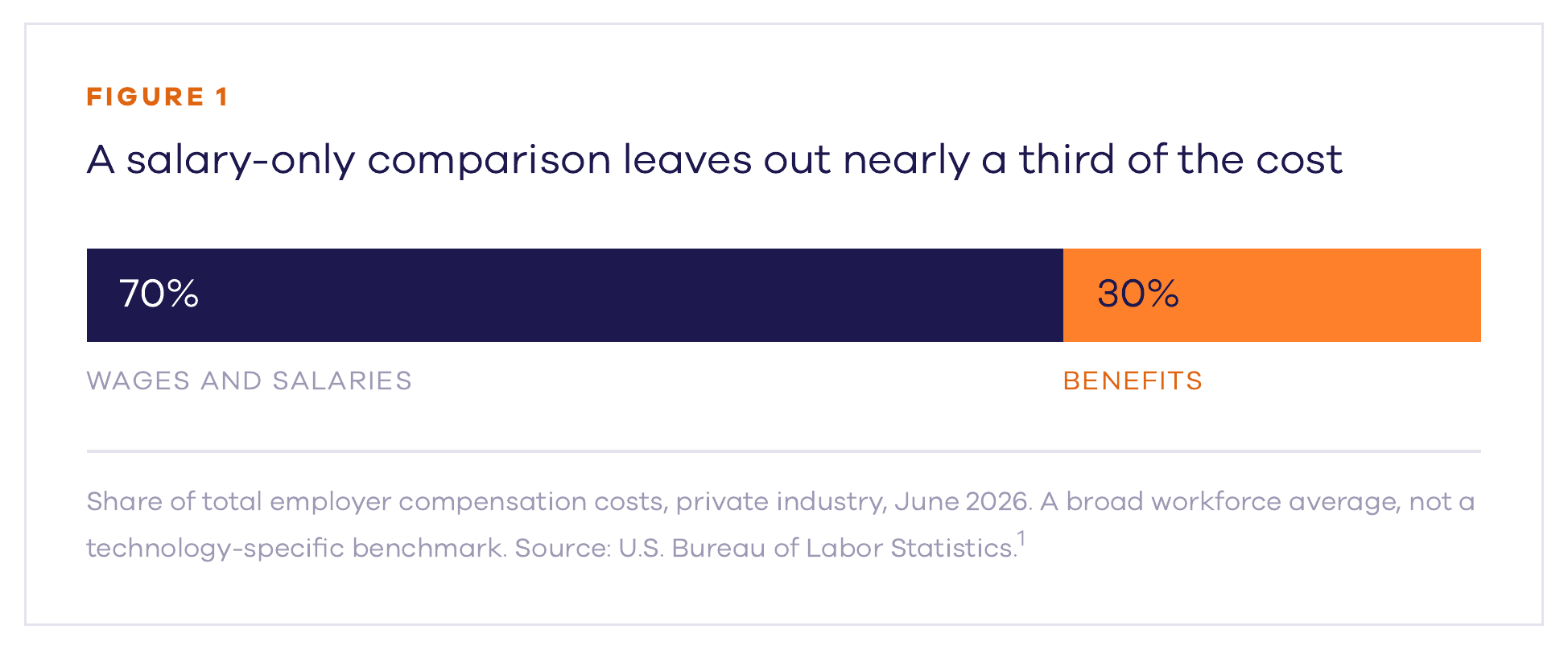
Consider the difference between salary and compensation. According to the U.S. Bureau of Labor Statistics, benefits accounted for 30 percent of total employer compensation costs in private industry in June 2026. Wages and salaries accounted for the other 70 percent. That is a broad workforce average, rather than a technology-specific benchmark, but it demonstrates how much a salary-only comparison can leave out. [1]
The capabilities people bring to a project is another factor. For example, in its 2025 Pulse of the Profession report, the Project Management Institute found that project professionals with high business acumen reported better budget adherence than their peers: 73 percent versus 68 percent. [2]
For technology leaders and procurement teams, these findings raise a practical question: Are we evaluating the full cost of delivering the initiative, or only the most visible expense? Are we truly looking at cost savings potential or only one small piece of it?
In staffing, that conversation can narrow even further. While savings on a markup rate are clear on the day an agreement is signed, the consequences of a poor talent match may take months to appear.
PULL QUOTE
“While savings on a markup rate are clear on the day an agreement is signed, the consequences of a poor talent match may take months to appear.”
As organizations depend on contingent staffing and staff augmentation for complex technology projects ranging from AI enablement to digital transformation, looking to factors beyond bill rate can not only ensure a project’s financial success.
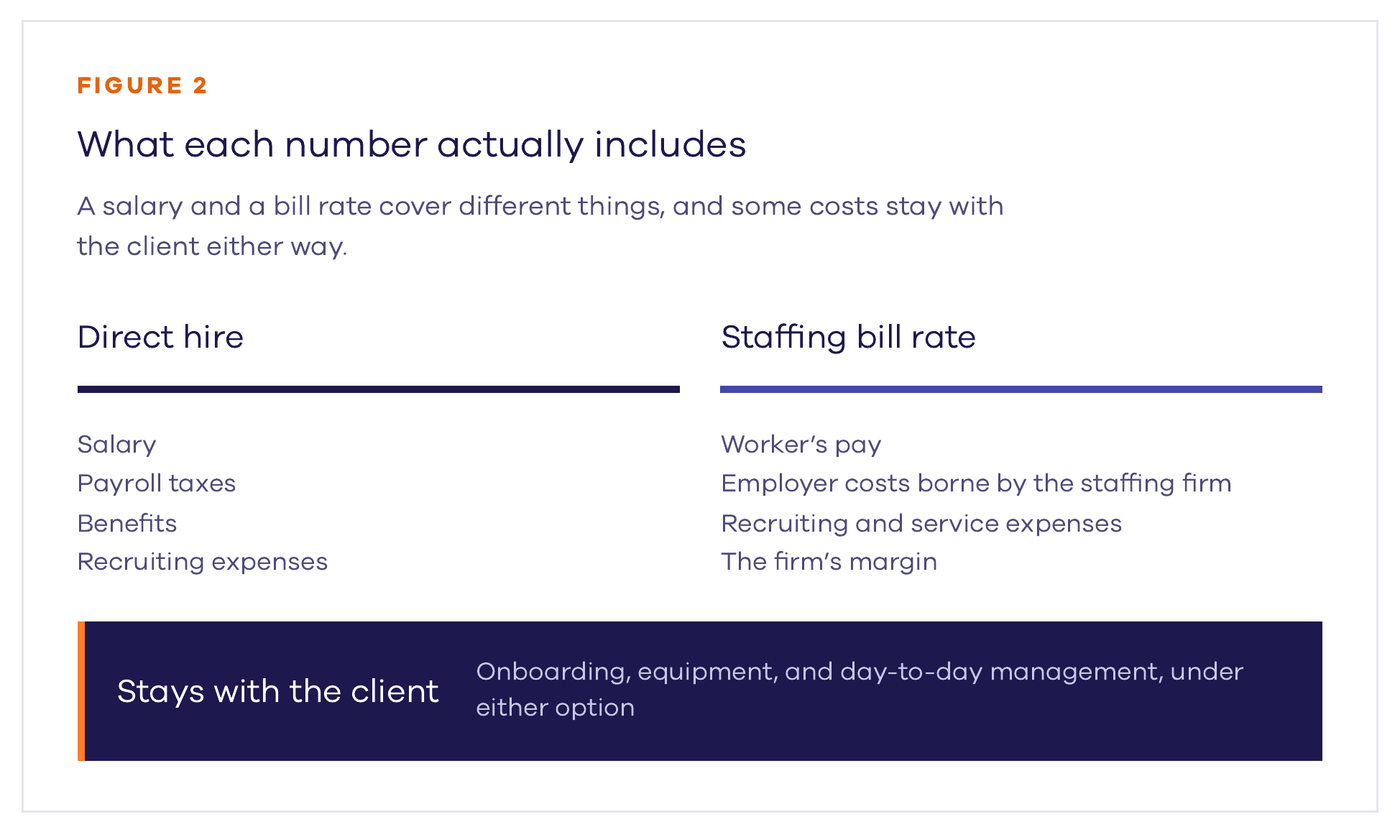
A contractor’s hourly bill rate and a permanent employee’s salary include different things. Comparing them directly can make one option look more expensive before the actual economics have been examined.
An employer hiring directly assumes costs beyond salary, including its applicable payroll taxes, benefits, and recruiting expenses. A staffing bill rate generally includes the worker’s pay, employer costs borne by the staffing firm, recruiting and service expenses, and the firm’s margin. The client still has responsibilities and costs of its own, including onboarding, equipment, and day-to-day management.
The same scrutiny belongs in comparisons between staffing proposals. An employer-of-record arrangement for someone the client has already sourced provides a different service from an engagement that includes finding, evaluating, and recruiting a difficult-to-locate specialist. Comparing the markups without understanding those responsibilities can obscure what each provider is being asked to deliver.
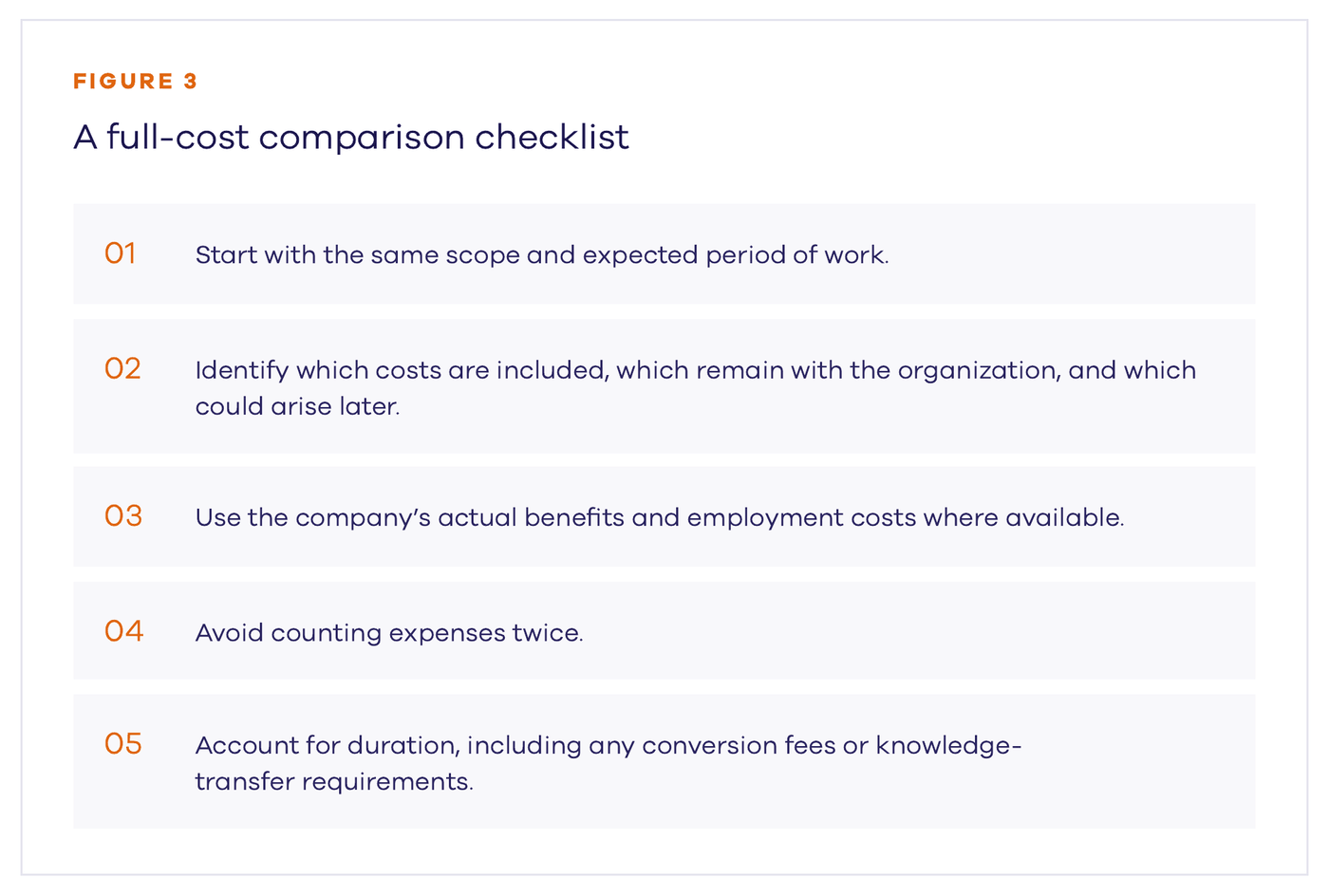
Start with the same scope and expected period of work. Identify which costs are included, which remain with the organization, and which could arise later. Use the company’s actual benefits and employment costs where available, and avoid counting expenses twice.
Duration also matters. A specialist needed for a defined implementation phase presents a different financial decision from someone who will own a critical environment for years. The comparison should reflect that distinction, including any conversion fees or knowledge-transfer requirements. This gives leaders a defensible basis for choosing the arrangement that fits the work.
Technology work is interconnected. If a data migration falls behind, testing may move. A delayed integration can keep another team waiting. An unresolved requirements issue can send developers back through work that appeared complete.
These costs may appear in different budgets, which makes them easy to miss when evaluating a single hiring decision. A project manager absorbs more coordination work. Senior engineers spend time correcting problems. The business continues paying for an older system while the replacement remains unfinished.
For example, at $100 an hour, 800 hours of work costs $80,000. At $90 an hour, the same 800 hours costs $72,000. The lower rate saves $8,000 if the scope and outcome are equivalent. If that engagement requires 900 hours to deliver the same work, the cost becomes $81,000, before any effect on other teams for the delay is considered.
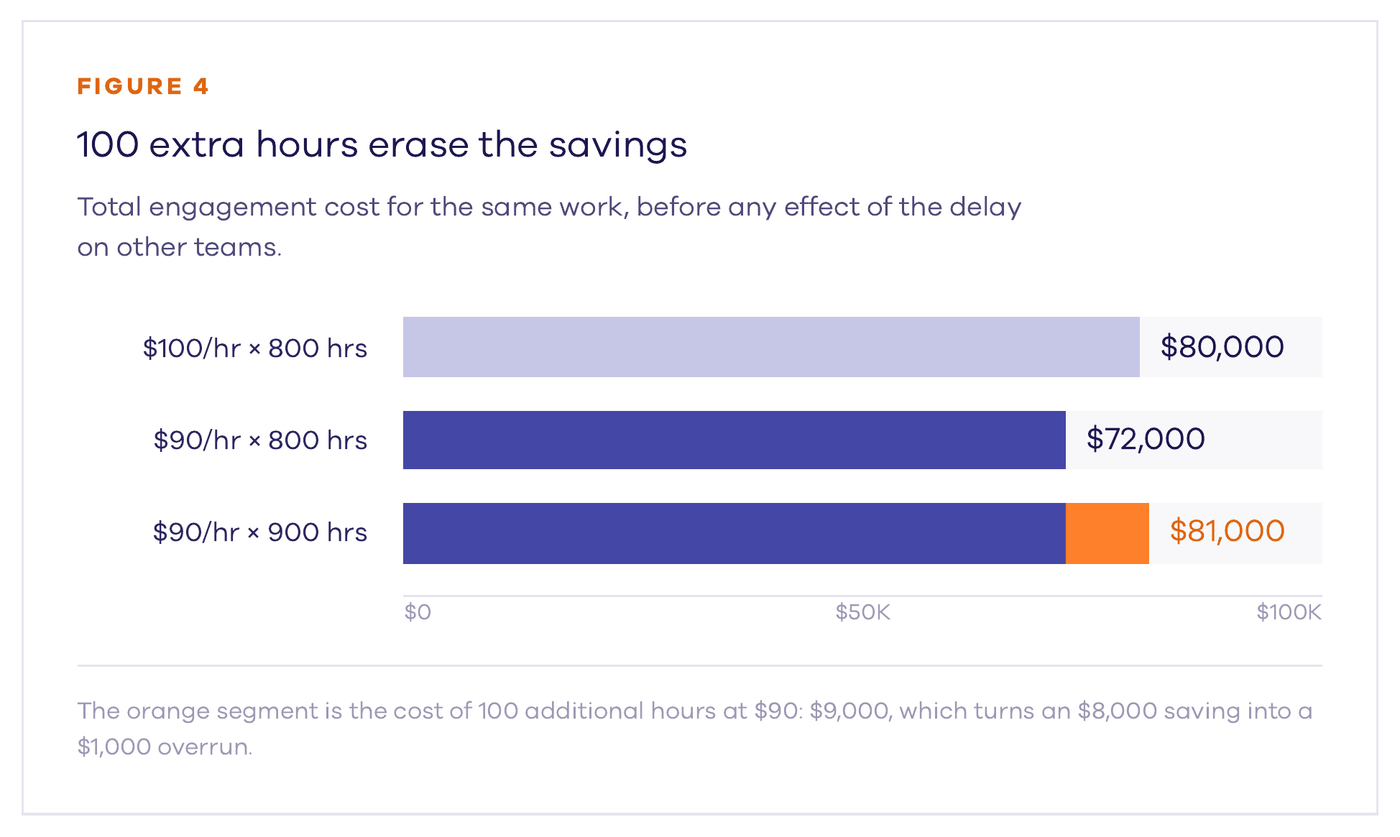
This isn’t to say that a lower-wage contractor will always take longer, but it’s possible and the cost-consequences can be high.
That is why candidate evaluation should examine the actual environment. Has the person handled a comparable migration? Can they translate business requirements into technical decisions? How much direction will they need, and does the existing team have the capacity to provide it?
PULL QUOTE
“Even a well-qualified professional will struggle without clear priorities, access to systems, and timely decisions.”
Employers have a role in those answers. Even a well-qualified professional will struggle without clear priorities, access to systems, and timely decisions. Understanding those conditions helps a company distinguish a skills gap from a delivery problem that another hire alone cannot solve.
Procurement teams are responsible for controlling spending and technology leaders are accountable for execution. Both, however, need a shared view of how the talent decision will affect the project.
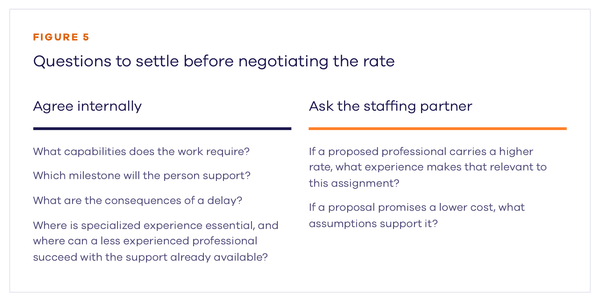
Before evaluating proposals, agree on the capabilities the work requires, the milestone the person will support, and the consequences of a delay. Decide where specialized experience is essential and where a less experienced professional can succeed with the support already available.
This creates room for more precise savings. A company may need an experienced architect for a limited design phase, followed by a different team for implementation. Clearly defined work may be suitable for a lower-cost delivery model. Better requirements can reduce the need to pay several people to revisit the same decisions.
Staffing partners should be accountable for explaining their recommendations. If a proposed professional carries a higher rate, what experience makes that relevant to this assignment? If a proposal promises a lower cost, what assumptions support it? Buyers should be able to examine both.
Continue that evaluation after the person starts. Review progress against milestones, the amount of supervision required, and any recurring rework. When a project slips, investigate the cause before assuming the remedy is either more people or a cheaper replacement. Early feedback gives the employer and staffing partner a chance to address the issue while it is still manageable.
Every organization should challenge its technology labor costs. That challenge becomes more useful when it includes the full employment or engagement expense, the capabilities required, and the effect of the decision on the rest of the project.
Sometimes the lowest-rate option will be the right one. Sometimes a higher rate, a shorter engagement, or a permanent hire will produce better economics. The decision should be supported by the work and the evidence available.
The real test of a talent cost decision comes when the work is delivered. Leaders should be able to explain how the savings held up through execution, and what the organization received for the money it spent.
1. U.S. Bureau of Labor Statistics — Employer compensation costs in June 2026
2. Project Management Institute — Pulse of the Profession 2025